

%20Enar_Pratar.webp)
FEATURE STORIES
Inside the mind of Enar
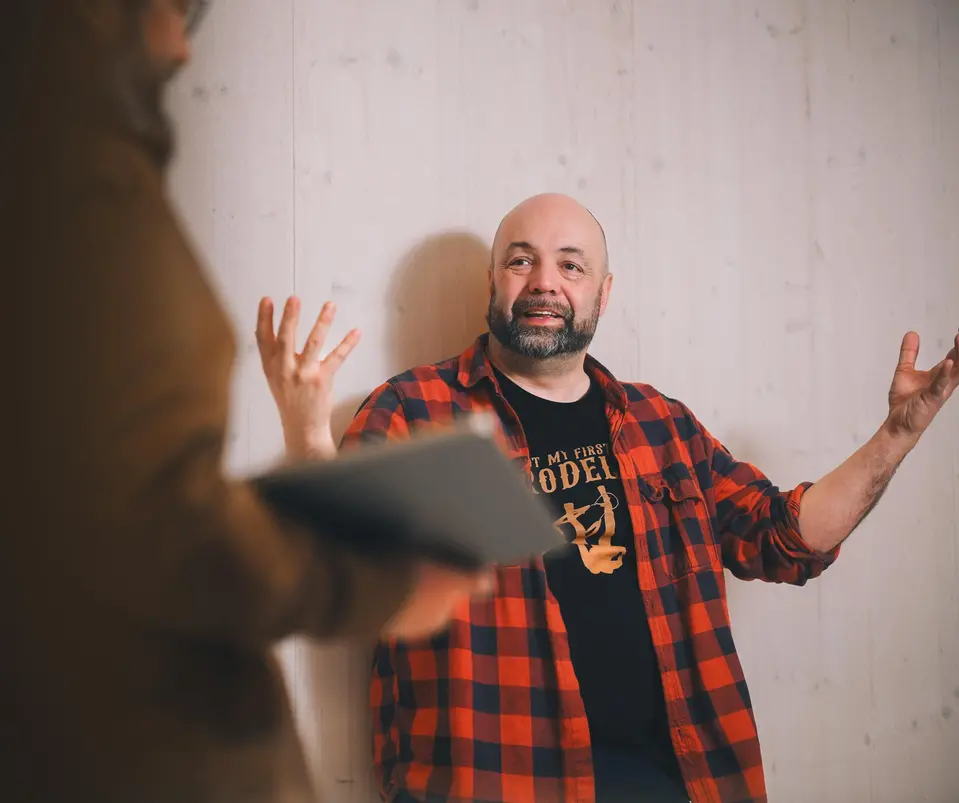
Enar Nordvik was actually supposed to become a comic book artist. Instead, he became an architect and a bureaucrat—a turn of events that says a lot about how life tends to take paths that can’t really be mapped out in advance. Not even in the comic series about Enar.
He walks into the Svalan municipal building, slightly sweaty and unshaven, 50 minutes late. The night train from Stockholm was delayed, and the management meeting has both started and already ended.
“If you miss one meeting, there are a thousand more to make up for it,” he notes.
Enar Nordvik has been at an architecture conference and is diving right back into his daily routine as head of building permits for Skellefteå Municipality. The department has 32 employees, but only eight are in the office this morning. The rest are working remotely.
On Fridays, the team reviews the week’s building permit applications. The documents are sorted, additional information is requested, and potential issues are identified.
“My team can process a building permit in three to four weeks, but since it’s so difficult to get all the necessary documents together, it’s taking longer and longer. We don’t start working until everything is complete. We need to help people improve in this area.”
To test the system, he applies for a building permit himself, incognito, about once a year.
“So far, I haven’t managed to submit a complete set of documents.”
Once, the members of the building committee even got to try out the process.
“What kind of damn rules are these? Is all this really necessary?” they asked.
“Yes, that’s what you require of applicants,” I replied.
It ended with a minor revolt and a mandate to make the process more understandable.
Working with building permits means having a reputation for wanting to make life difficult for honest people. That’s probably the case all over the country, but the reality is more nuanced.
– Many people have borrowed money down to the last doorknob. The bank is breathing down their necks, and the contractor is waiting. I understand that people don’t always find it easy to grasp our complicated rules. But considering that the definition of a government agency is the right to make decisions for others, we still get a surprisingly large number of positive comments,” he says.
Further down the hallway sit other departments within the public works division—sometimes clients, sometimes colleagues.
“Sometimes we have to send them fines, too. Then the mood at the coffee table can get a little tense,” he notes cheerfully.
It was pure chance that Enar ended up in the world of building permits. He had planned to become a comic book artist, but tagged along with a friend who was applying to architecture school.
His friend didn’t get in, but Enar did.
The move from Skellefteå to Stockholm was a culture shock, worse than the one from the inland to the coast. Many of his classmates had architects for parents, and few had a surname ending in “-son” like Enar did at the time—Persson. Today, almost all of them have switched to something more like an architecture firm, he notes laconically.
In his free time, he got involved in what he calls Sweden’s smallest local chapter of the Left Party—in Östermalm.
Over the years, Enar has heard two rumors about himself. One is that he’s a hardline Stalinist, and the other is that he’s an ultra-liberal who goes along with whatever the business community wants.
He himself tries to strike a balance between the two labels.
“I think it’s important that we get some hands-on experience as self-employed people a little more often and try to put ourselves in their shoes. I know my paycheck comes every month, but that’s not the case for all business owners. Everyone probably benefits from taking a broader view every now and then.”
When he finished his education, he moved back to Skellefteå, tired of what he describes as social insularity. Ironically, he later ended up on a street in Alhem where most of the city’s architects live.
At the university, he earned his Ph.D. in wood technology while also serving on the building committee. From there, he was headhunted to the planning department as an architect, and after just over ten years, he became the head of building permits.
“I was raised in a spirit of freedom, to be a bit of a cowboy, while at the same time I’m supposed to be an official and a bureaucrat. It’s not exactly easy to come to terms with myself—those two wolves inside me that are fighting.”
%20Enar_Brottas.webp)
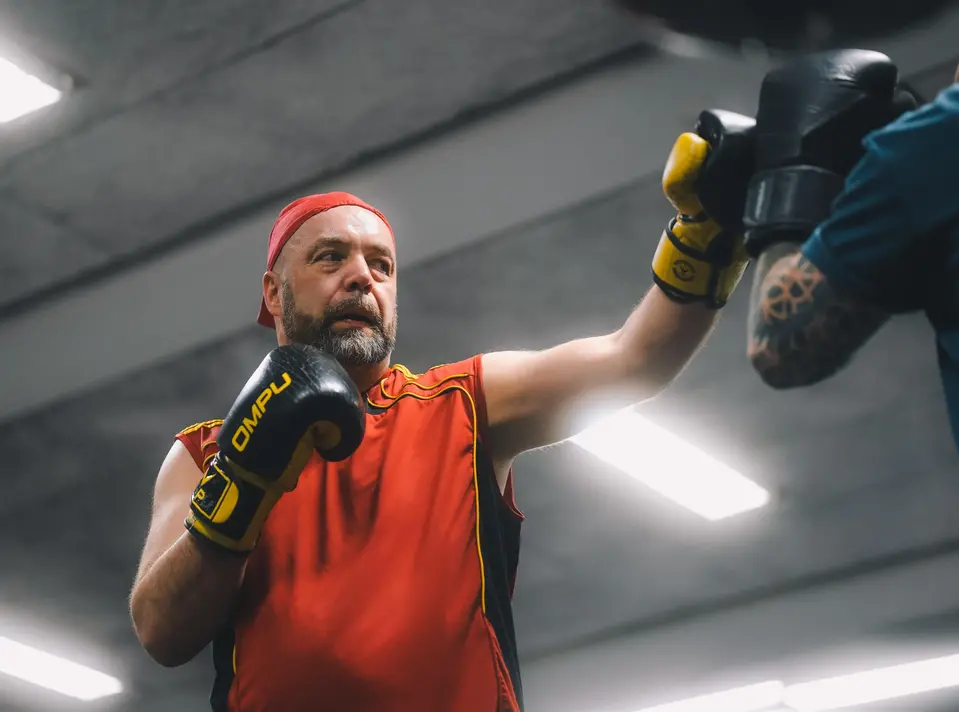
Enar doesn't have much of a capacity for violence, but learning to take a punch is good for you, he says.
He grew up in the small village of Böle in Norsjö Municipality, where his family has always lived.
“We’ve moved about one and a half kilometers in six hundred years. We don’t talk about inbreeding; we prefer the term ‘refinement.’”
That’s a typical Enar joke, but it’s delivered in a way that makes you wonder if it was even a joke at all. He switches back and forth between laughter and seriousness in the blink of an eye, but says himself that he’s trying to stop hiding behind his laughter.
Roots have always been important. He noticed this especially when he visited a childhood friend in Stockholm who worked at Spotify.
“For them, their roots were everywhere. For me, they’re in a very specific place, and I don’t know anything else.”
Over the years, he himself has become part of the establishment he once stood outside of.
“I usually think that if I weren’t doing this job, someone else would do it anyway—and maybe do it worse. But of course it’s strange to hate my own class while at the same time raising middle-class kids in Alhem.”
His years as head of the building permits department have coincided with Skellefteå’s most expansive period in living memory—what he calls the Klondike years. The building permits department was under enormous pressure, but both the staff and Enar rose to the challenge.
– The media’s logic says everything is either heaven or hell. But the story isn’t over yet, and in many ways, Skellefteå is still in a better place now than it was before Northvolt. We’ve gone from being Sweden’s largest village to a small city.
– We meet people other than those we went to high school with, and the restaurant scene is better. The journey has changed both the city and its people. God, now I sound like a Robert Broberg song. But as someone said: “Maybe the real battery factory was the friends we made along the way.”
We slip into a digital meeting with the City of Piteå that wraps up in seven minutes. They need help with building permit issues and are swamped, while Enar’s staff has openings to fill.
“It would be fantastic if we could work this out,” says the Piteå manager.
We quickly move on to more meetings—one about the travel center and one about the architecture gala. Then, participation in the city’s Pride parade is on the agenda.
“Hard hats with rainbow stickers feel a bit like the YMCA, but it should work.”
The workday ends at 4 p.m. Enar heads home to his heritage-listed brick villa in Alhem. Much of the original 1962 design has been preserved, and there are certainly typical architectural features here. But the cowboy hat hanging on the old textured wallpaper stands out and is very much Enar.
He bought it in that little Texas backwater where his daughter plays college basketball. During his visit, he noted how uncomfortably similar it was to Norsjö—the same deeply rooted sense that power lies elsewhere.
Enar’s partner sometimes wonders if he can think without talking, and there’s probably some truth to that, he says.
“I can’t make sense of the world on my own. My own thoughts usually take shape through encounters with the ideas of others.”
That’s where his book club plays an important role.
“I have a hard time learning anything from books other than fiction. And it’s nice that these old guys have already survived everything that happens to me.”
Because things happen in life.
Like becoming a parent. Or divorcing my childhood sweetheart after almost 30 years.
“I hope I’ve become a better person. I’m not that railbus anymore that just runs on the same track. But I’m probably still a bit one-eyed and single-minded at times. It simply takes time to change direction.”
A little over twenty years ago, his life changed in another way when his younger brother was killed in a traffic accident.
“There’s a before and an after Stefan.”
Since then, he’s been more careful about how he spends his time.
Tonight, boxing practice awaits.
“Nah, everyone in my family probably has a lot more fighting spirit than I do,” he notes as he packs his gym bag.
But the training does him good.
“You learn both how to take a punch and how to throw one.”
When the session is over, another workday awaits—and a thousand more meetings.
Text: Daniel Bergeman
Photo: Tilda Olofsgård
